
Future Memories
It won’t be a walk in the park | Fiction | Fresh Soup

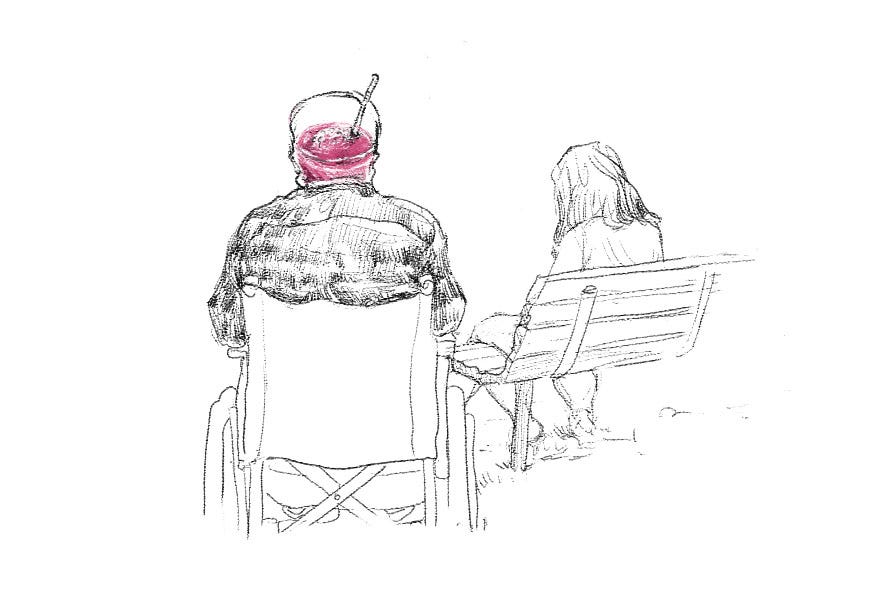
Years from now, I’ll be sitting in my wheelchair in the brightest spot in Amsterdam Park, next to the old wooden swings, catching a bit of sun. Next to me, on the new bench that some future mayor will have put there, will be my caregiver who came from a faraway country. She’ll know very little Hebrew, and at my old age, I’ll also remember only a few words—in Hebrew or at all.
By then, my memory will have crumbled like an old biscuit left in a coat pocket since last winter, and every time my caregiver calls me “Papi,“ I’ll think she really is my daughter. Those moments in which the past is erased and replaced by an invented history will be my most meaningful ones. They will be what keeps me alive.
That word, Papi, which she’ll always say hesitantly, as if for the first time, will fill me with pride for my talented daughter, but also with shame at being unable to remember anything of her childhood, or even her mother’s name.
Sometimes, when I talk about her childhood, my face will be damp with tears. “I’m sorry, I’m sorry,” I’ll murmur over and over again, “I’m sorry I wasn’t there for you when you were a little tot. I’m sorry I didn’t hold onto any memories, any pictures.” And she’ll nod and hand me a plastic bottle full of fizzy orange liquid. As I said, she’ll have almost no Hebrew, my caregiver-daughter, and whenever I tell her something emotional, she’ll think I’m grumbling about being thirsty. Apparently my daughter grew up in some kind of desert, where a sip of juice is the answer to any distress.
My wife will have died by then, and her soul will be reincarnated in a crow that will stop by Amsterdam Park to say hello every so often. My son, with graying hair and a receding hairline, will live in America, in a city whose name I’ll keep forgetting. I won’t always remember his name either, or even his existence. When he comes to Israel for those quick visits, he’ll sit in the sunny park with me and my caregiver, and I’ll be convinced he’s there to win her heart and take her away from me, because that is the way of the world. But deep down inside, as a father, I won’t be able to avoid the thought that my daughter deserves something better than this lanky, balding man who keeps bothering us in the park. “Want to see pictures of your granddaughter?” he’ll ask, waving a shiny American phone at me. “It’ll never work,” I’ll tell him, “she’s too good for you. Go find another woman.”
Before he flies home, my son will always take a selfie of the three of us. My caregiver will print out one of these pictures and frame it and hang it in the living room next to a black-and-white photo of me in army uniform, crying at the Western Wall. When I look at those two pictures, I’ll feel so proud: what began as the tearful, black-and-white loneliness of my youth will have blossomed, over the years, into a three-way embrace in cheerful technicolor with two dear people whose names escape me.
A closer look at the newer photo will reveal a crow perched on the armrest of the bench. My wife always loved group photos. The caregiver will offer her a piece of eggplant bourekas. My wife will hesitate before pecking at it. Kra-kra, she’ll caw at my caregiver. Which means: “Why get fancy? What’s wrong with cheese bourekas?” My caregiver will say, “Papi, you thirsty?” and instead of answering, I’ll just keep looking deep into the dark brown, displeased, crow-eyes of my wife. The first time we met was on the campus lawn more than fifty years ago. She told me that day that her two favorite things were Bergman films and skinny-dipping in the sea. Now she’s a crow.
The move that holds this together is that every failure of memory produces something more tender than what it replaces — the caregiver becomes a daughter, the wife becomes a crow who still has opinions about bourekas. Dementia as a generator of love rather than loss. The last line lands because it doesn't ask you to feel sad. It just states what happened. Devastating and beautiful! Thank you.
Reading this story was an intensely emotional experience.