
Implausible Dogs
Close to the bone | Fiction | Fresh Soup

Surgeons probably have it before they perform surgery, bus drivers have it when they get to a busy intersection, and I bet pilots feel it in their gut before takeoff and landings: that weighty knowledge that they’re about to do something tricky, and if they don’t do it well, someone could die. As a writer, I’m exempt from this predicament, but as a boy I experienced a similar sense of petrifying responsibility every time I took our dog Maggie for a walk. It made the walks a complicated blend of pure joy and mini-panic-attacks, until one day my brother took Maggie out, and she ran away and got run over. It was an extremely painful experience for my brother and the whole family, and ever since then, I can’t stop writing guilt-ridden stories about run-over dogs. This particular story, though, has an unusual angle.
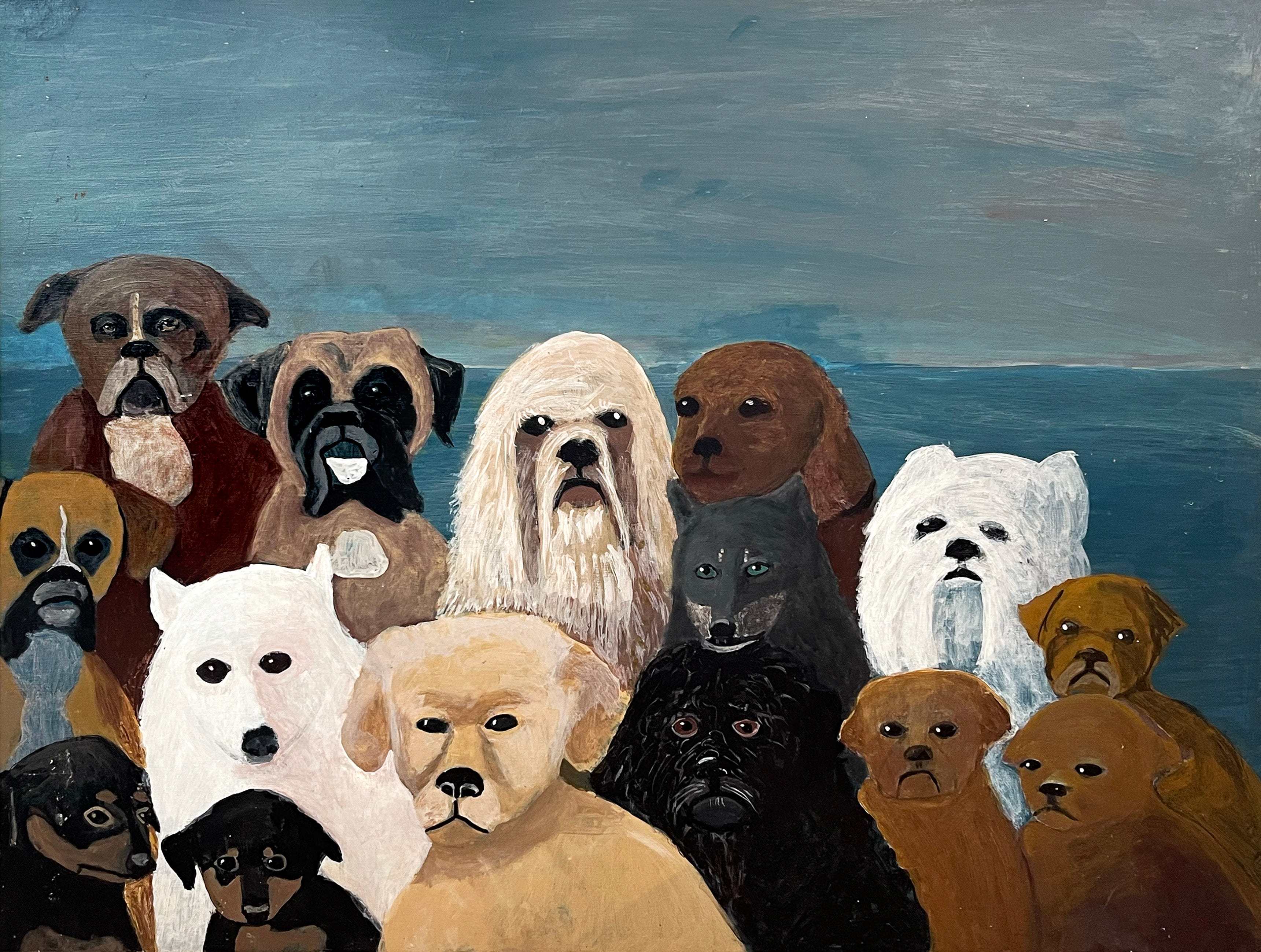
Just over a year ago, I started performing with the gifted musician Arkadi Duchin. During rehearsals, I would try to get Arkadi to tell me more about his childhood in Belarus, in the same region where my father grew up. The atmosphere depicted in his stories was extreme and emotionally intense. In one of our talks, he told me how, as he left school one day, he was surrounded by “a gang of implausible dogs.” That image of a boy standing in the schoolyard, caught in an irrational scene that unfolds with the logic of a fable, would not let go of me until it was written.
Whenever Vitaly heard Dad’s car pulling up, he’d start barking and going berserk like he’d won the lottery. He’d have killed just for Dad to stroke him once. So would I. And Dad, he may not have stroked much, but he loved Vitaly a lot. At least as much as he loved me and Mom.
The first thing the pickup truck driver said after he ran over Vitaly was, “You OK, kid?” And as soon as I said yes, he just kept blaming me and cursing. “What kind of an idiot walks around with an unleashed dog on such a busy street?” he said. “Did you see how he jumped in front of my wheels? You tell me, kid—what could I do?” I told him he couldn’t have done anything and that he wasn’t to blame, it was all my fault, and then he calmed down. “All right,” he sighed, and bent over to pick up Vitaly’s body, “come on, I’ll take you home.” In the pickup, I gave him my school’s address because I didn’t have the guts to go home with Vitaly. I was scared. I was scared of what Dad would do when he found out Vitaly was dead, and of what would happen if he found out it was my fault.
When I was little, we had a genius pet guinea pig called Gabriel. Gabriel could spin in his little wheel in both directions—backwards and forwards—and when they played the Red Army Choir on the radio, he would bob his head to the rhythm like an old man. Once every few days, Gabriel tried to get out of his cage, and on one of those escape attempts, I accidentally stepped on him. When Dad heard I’d killed Gabriel, he totally lost it. He didn’t hit me very hard when he punished me, and it didn’t hurt much, but he cried while he did it, and not just a few tears: he was sobbing. That was the only time I saw him like that: crying and hitting. It was frightening.
The pickup driver was a chatterbox but he was nice. He told me he was from a faraway city, and he didn’t have a dog but he did have a trained chicken called Mathilda, who could hunt snakes. When we got to the school he was a little surprised and asked where exactly I lived. I lied and said my dad was the school janitor and we lived in a hut behind the main building. After he drove away, I carried Vitaly to the sandy lot where we played soccer at recess. He was heavy. Heavier than I’d expected. He weighed almost as much as a person.
I buried Vitaly with my own hands. It took almost two hours. When I finished digging, my arms and knuckles hurt, and it even hurt under my fingernails. I put Vitaly in the pit and looked at his strange face. When he was alive he always looked sad—always, the way Dad looked angry even when he was asleep. But now, as he lay there dead in his grave, he looked happy. I put the leash near him but not quite touching, and then I covered him with the sandy earth and tamped it down really well.
When I got home I saw my big brother at the front door. “Now you get here?” he said. “Do you have any idea how worried Mom is? If not for Dad she’d have called the police by now. Where’s Vitaly?” Instead of answering, I walked inside. Mom and Dad were sitting in the living room watching TV. “He’s here!” Mom cried out and stood up dramatically. “Thank God! I thought you were dead.” Dad didn’t get up. “Where’s Vitaly?” he asked. “Ran away,” I said and then I started to cry. Mom wanted to hug me but Dad signaled for her to sit back down and not interfere. He came over and squatted down next to me on the rug. “How did he get away?” Dad asked. “He saw another dog, a poodle with no leash, and he started chasing him,” I lied, “he pulled on the leash and I held on as hard as I could but he was too strong. You know how strong Vitaly is, Dad.” “I’m sure he’ll come home,” Mom said from the couch, “he’s a smart dog.” I saw in her body that she wanted to get up. “When you pulled hard,” asked Dad, “did you wrap the leash around your hand like I taught you?” “Yes,” I said, “I wrapped it but he pulled really hard…” “And the sand under your fingernails?” Dad jerked his chin at my hands. “How does that fit in with the story?” “It doesn’t,” I said, “this morning at school me and some other kids from class dug a hideout.” Dad kept the interrogation up: “And you haven’t had time to wash your hands since this morning?” Instead of answering, I shut my eyes. That night, I got a beating from Dad, but it wasn’t nearly as bad as I’d feared. He didn’t even take his belt off. He was angry but he didn’t cry. I could see he was convinced Vitaly would come back.
I never told anyone the truth about Vitaly. Not even my brother. But I did go to his grave almost every day at recess. I went for him, so he wouldn’t be alone, but mostly for me. And very gradually, everyone got used to the dog being gone. After a few months, even Dad stopped talking about him.
On the one-year anniversary of Vitaly getting run over, I went to his grave. It was a Saturday, so I didn’t have any excuse to go to school, but I lied and said I was going to play with some friends. I wanted to take him something, so I stole a bone out of the trash. The school was empty. I sat down by the grave and thought about Vitaly and what this past year would have been like for him. If I’d taken better care of him, if he were still alive. Suddenly I heard a dog’s rhythmic breathing from behind me. When I turned around, I saw a strange pack of about twenty implausible dogs. Each one of them looked peculiar, but in a different way. There was one tall dog who was so skinny that you could see all his bones, and a tiny one wearing a sweater, and a black one with its fur entirely covered in flowers and leaves.
The dogs stood there without moving and stared at me. They looked like a gang. Their leader was a panting, one-eyed AmStaff, who broke away from the pack and started walking toward me. He didn’t growl or bare his teeth but he looked determined. I kept sitting by the grave, trying not to move. When the AmStaff was right up close to me, he started sniffing. “What’s in your pocket?” he asked. I’d never heard a dog talk before. And that’s why I thought I was imagining things and I didn’t say anything. “I’m not going to ask you again,” the AmStaff muttered and bared his teeth. “A bone,” I said, “I have a bone in my pocket.” I held it out to the AmStaff. He didn’t touch the bone, just kept looking at me with his one eye. “Why are you walking around with a bone in your pocket?” he asked. “Vitaly,” I whispered, “my dog. He’s buried here.” The AmStaff shook his head from side to side. “If he’s dead, what’s he supposed to do with the bone?” “Nothing,” I admitted, “it’s just so he’ll know that I love him. And that I’m sorry…”
The second I said that, I knew I’d made a mistake. Now that I’d said I was sorry, the AmStaff would want to know what for. He was a dog, not a dad, and dogs can always smell a lie. When he found out Vitaly had died because of me, he’d probably bark an order and all twenty implausible dogs would rip me to shreds. But the AmStaff didn’t say anything, just nodded and then turned around and left. He walked to the school gate and the whole gang followed him. To me it felt like a memorial procession for Vitaly. I buried the bone in the sand right next to him and the leash, and then I washed my hands really well at the fountain and cleaned the sand from under my nails, and then, before I left, I put both hands on the earth over Vitaly’s grave, and apologized. I don’t know why I only did it then. I should have apologized long before that day.
The sand under the fingernails is the whole story for me. Dad sees it, knows exactly what it means, and lets the lie stand anyway. Then a year on it’s the one-eyed AmStaff who pulls the real apology out of him, the one he could never give his father. Forgiveness showing up in the wrong species, which is maybe the only place it could’ve come from. This will stay with me for a long time.
The magical reality of childhood can haunt us for years in small moments echoing over time.
small moments and emotional memories
Thank you for fresh soup.